
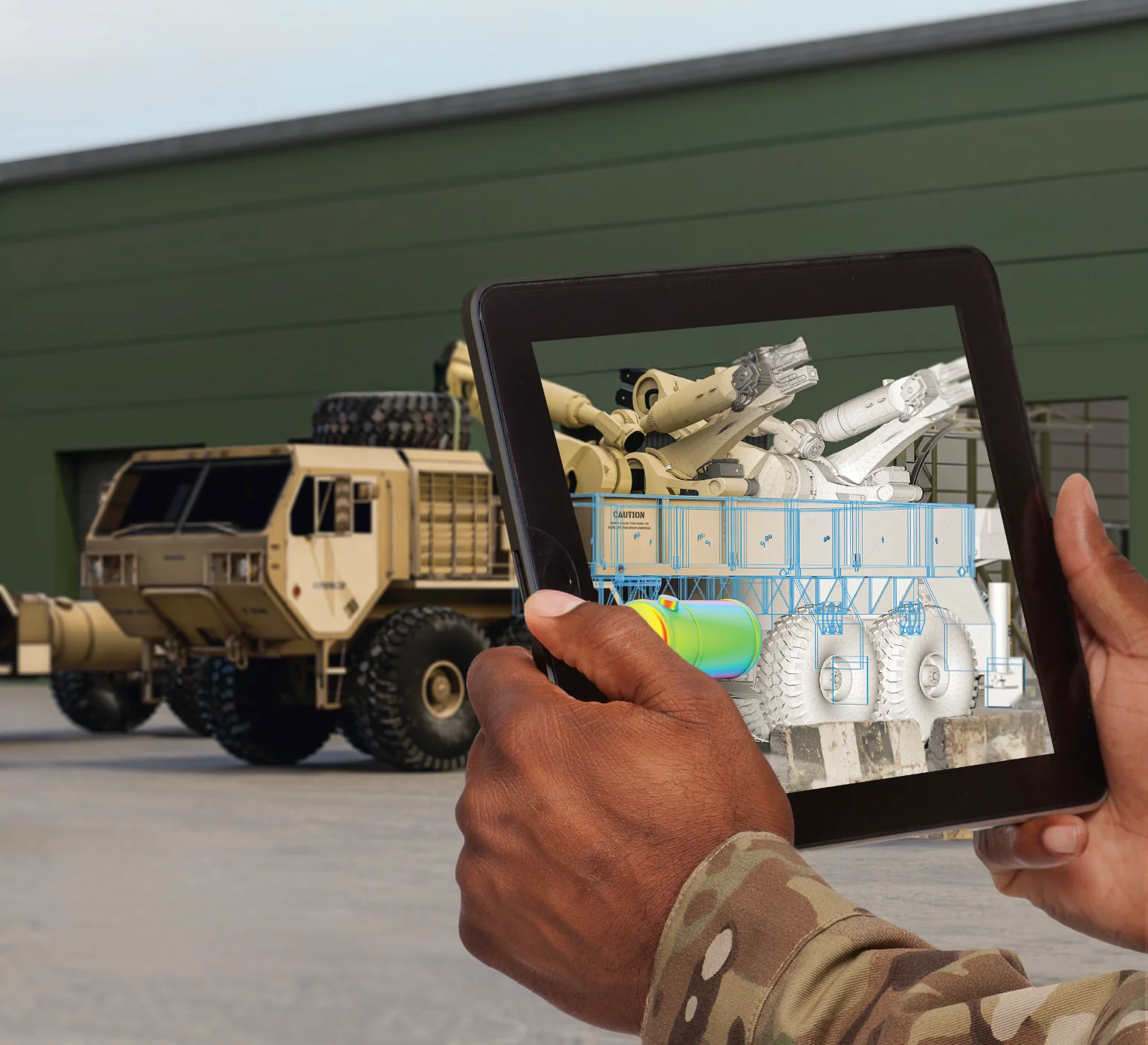
Military sustainment operations are increasingly conducted in remote, disconnected, and contested environments, where traditional supply chains cannot keep pace with mission demands.
Advanced manufacturing offers a path forward, enabling parts to be produced closer to where they're needed. However, most current approaches still rely on file-based manufacturing workflows, requiring sensitive engineering and manufacturing data to be transferred and stored between systems.
This creates significant risk. Once data exists at the endpoint, it becomes vulnerable to cyber infiltration, unauthorized replication, manipulation, or malware insertion (particularly in contested or low-trust environments).
As a result, advanced manufacturing has yet to scale effectively to the environments where it matters most.

Siemens Government Technologies enables secure, distributed advanced manufacturing by eliminating the need to transfer or store sensitive files altogether.
Using a secure streaming transfer approach integrated with Teamcenter, SGT delivers manufacturing instructions directly from the authoritative digital source to approved equipment in the field.
Rather than sending complete files, data is streamed in real time, ensuring that sensitive information remains protected while still enabling on-demand production.
This approach allows organizations to:
SGT's approach introduces a fundamental shift in how manufacturing data is delivered.
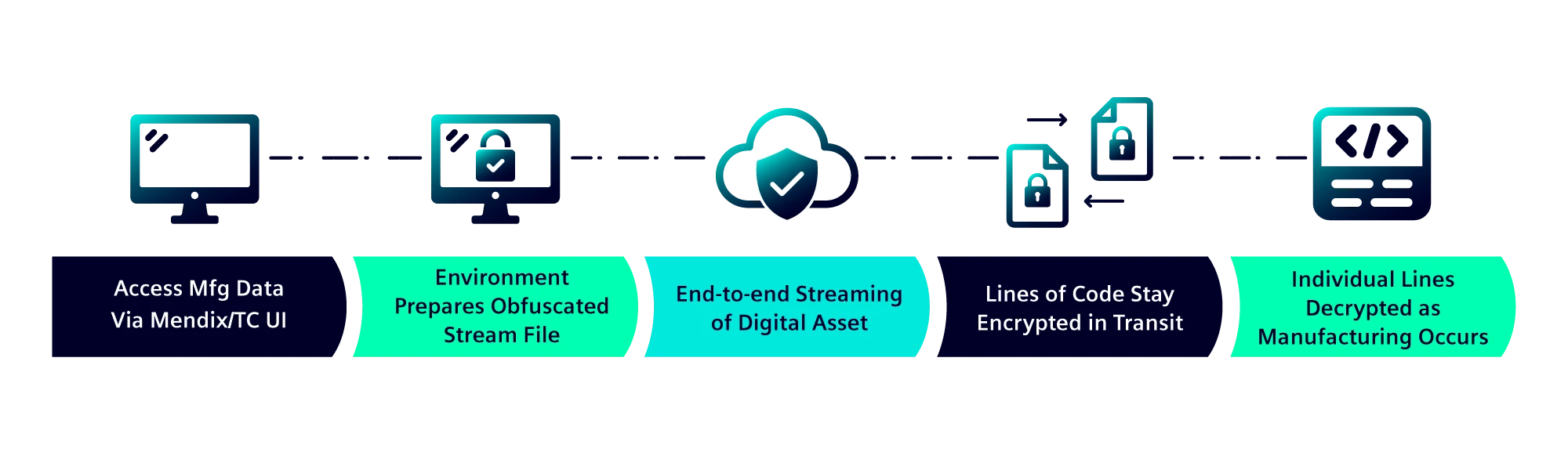
Much like modern movie or music streaming services, manufacturing instructions are delivered in small, encrypted packets. The complete file is never transferred, reconstructed, or stored — eliminating a major source of vulnerability in traditional workflows.
This "no-file-at-rest" model provides:
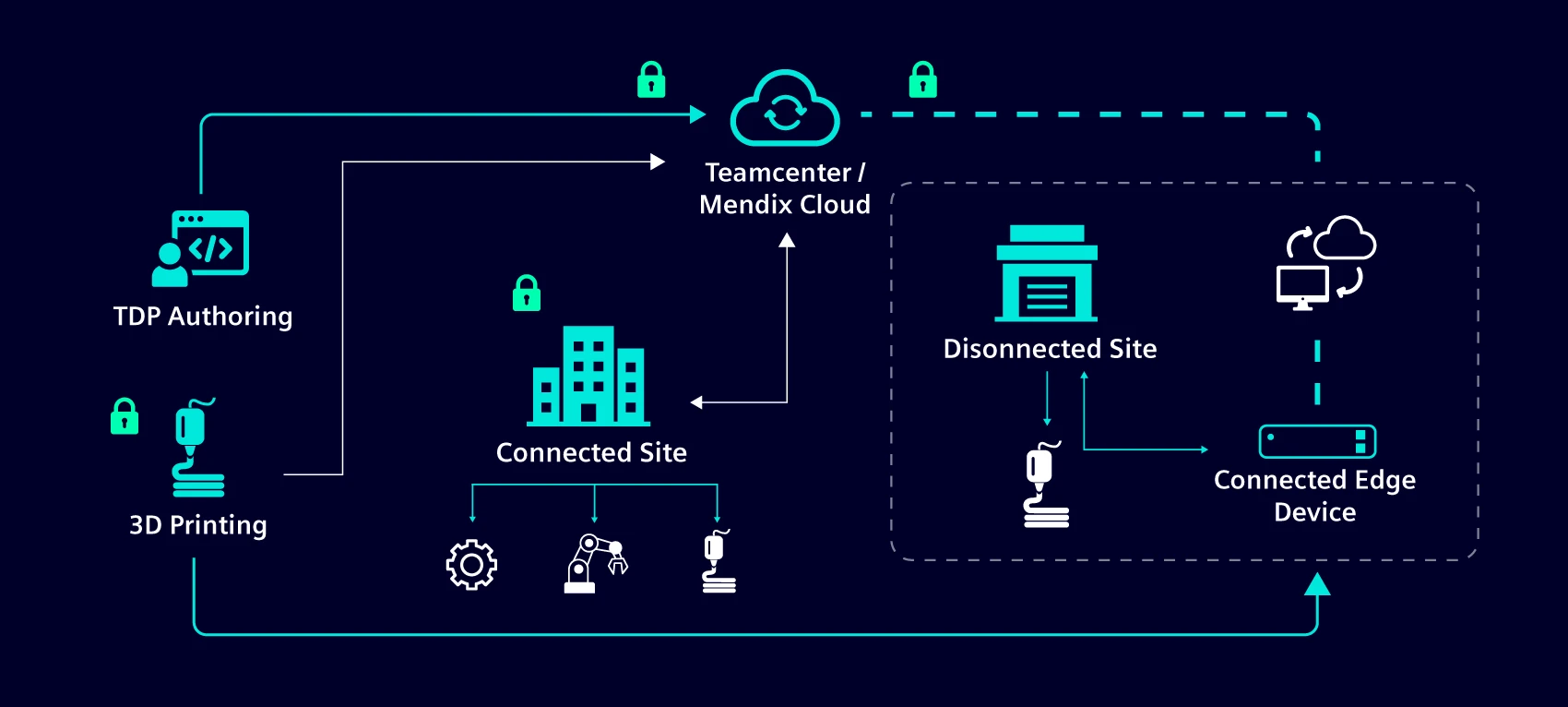
At the core of this capability is a secure connection between the authoritative digital thread and manufacturing systems in the field.
Engineering and manufacturing data is managed within Teamcenter, ensuring a single, controlled source of truth across the lifecycle. When a part is required, manufacturing instructions are streamed directly to the endpoint, enabling production without exposing the full dataset.
This architecture preserves configuration control and traceability, ensures consistency across distributed manufacturing sites, enables operation in degraded or disconnected environments, and supports scalable deployment across global operations.

This solution is designed for forward-deployed environments, with a focus on usability, speed, and reliability.
Through collaboration with operational users, SGT has developed a system that minimizes complexity while enabling rapid execution in the field.
Operators can quickly identify and produce parts through intuitive interfaces, with prequalified configurations and minimal training required.

SGT's distributed advanced manufacturing capability has been demonstrated across a range of real-world defense scenarios.
From maritime and expeditionary environments to large-scale distributed manufacturing exercises, this approach has validated the ability to securely deliver manufacturing data without exposing sensitive information.
These demonstrations confirm that secure, on-demand manufacturing can be achieved, even in low-bandwidth, contested conditions.
SGT's solution is built on a foundation of core capabilities that support operational deployment at scale.

Enables parts to be manufactured on demand across locations, supporting both connected and disconnected operations.
Ensures sensitive data is protected throughout the process, without relying on traditional file-based workflows.
Maintains consistency and quality by ensuring parts meet required standards across environments.
Allows for rapid adoption through intuitive tools that reduce complexity for operators in the field.

By enabling secure manufacturing at the point of need, SGT helps organizations overcome traditional supply chain limitations and improve mission outcomes.
Teams gain faster access to critical parts, reduce dependence on vulnerable supply chains, and improve readiness in contested environments, all while maintaining secure, scalable operations.
This capability also lays the foundation for the future of defense sustainment, enabling integration with advanced analytics, AI-driven demand forecasting, and expanded distributed manufacturing networks.
